The role of interpreters in the European Parliament
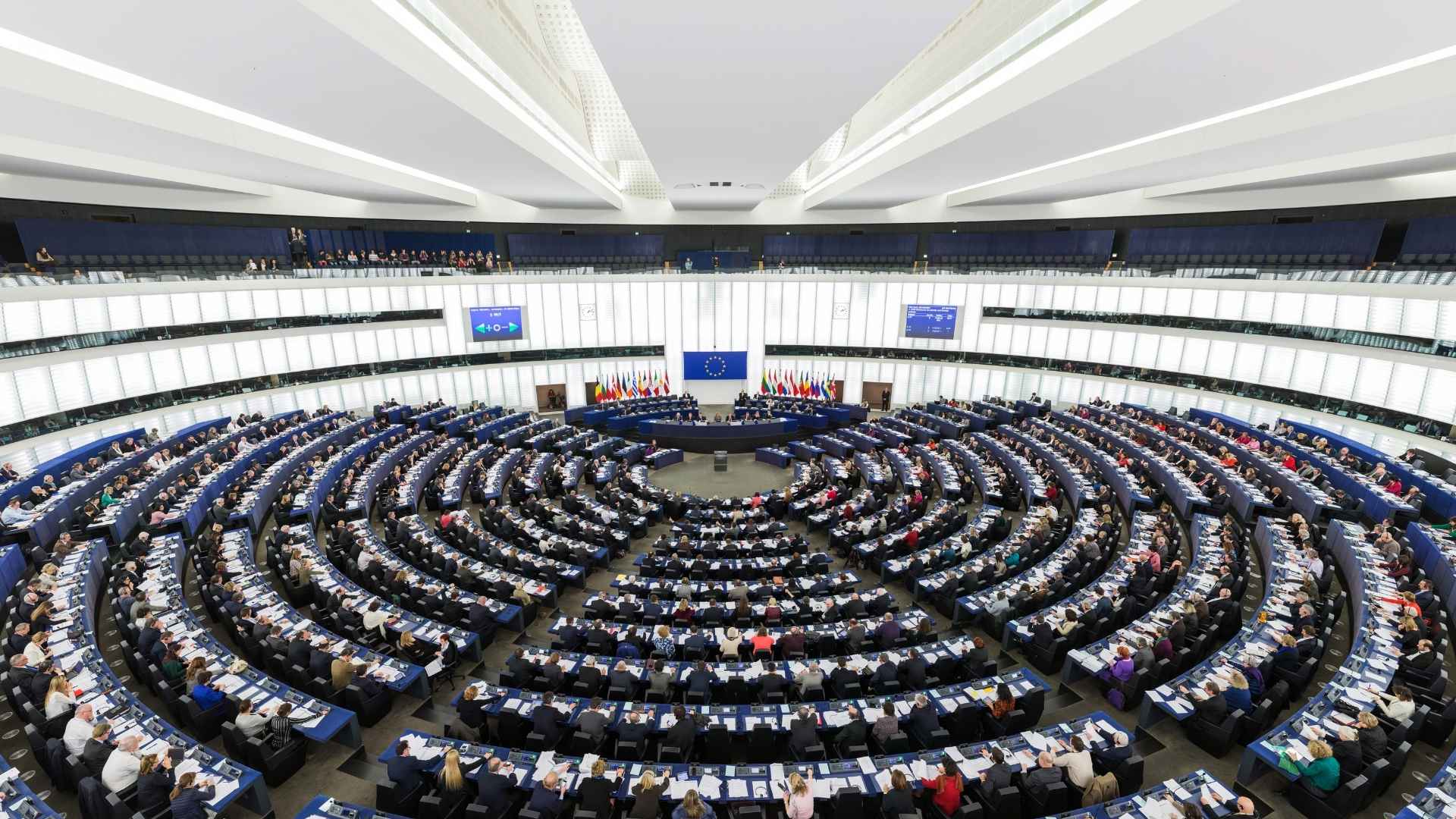
Just like in all other EU institutions, translators and interpreters play a crucial role in the European Parliament. In fact, the Parliament hosts one of the largest interpretation services in the world. And this didn’t happen overnight: the scale and importance of this work have grown exponentially over time, keeping pace with the expansion of the European Union itself. At its core, interpretation is what makes multilingual democracy possible. It allows Members of the European Parliament (MEPs) from different countries, cultures, and linguistic backgrounds to understand each other and work together seamlessly.
From 4 languages to 24: a story of growth
When the European project first began, things were much simpler. There were only four official languages, English, French, German, and Italian, resulting in just 12 possible language combinations. But as the EU expanded, so did its linguistic diversity, and with it, the complexity of interpretation.
In 1973, with the accession of new Member States, Danish and English were added (while Irish was used in a more limited way), bringing the total to 6 official languages and 30 language combinations. By 1981, Greek joined, increasing the count to 7 languages and 42 combinations. The trend continued in 1986 with Spanish and Portuguese, reaching 9 languages and 72 combinations. In 1995, Finnish and Swedish were added, bringing the total to 11 languages and 110 combinations.
Then came the big enlargement of 2004, when 9 new languages, including Polish, Hungarian, and Czech, entered the system, jumping to 20 official languages and a staggering 380 combinations. In 2007, Romanian and Bulgarian (along with Irish gaining full status) pushed the total to 23 languages and 506 combinations. Finally, in 2013, Croatian joined, bringing the EU to its current 24 official languages and 552 possible combinations. And it doesn’t stop there. Beyond the official languages, interpreters often work with languages of candidate countries, as well as global languages like Russian, Chinese, Arabic, and Japanese.
A highly specialised craft
Interpretation is not just about “speaking languages”, it’s a highly technical and specialised profession. Interpreters work with what are called active and passive languages. A passive language is the one they listen to, while the active language is the one they interpret into, the one the audience hears.
For less widely spoken languages, systems like “pivot” interpretation are used. This means one interpreter translates into a more common language, which then serves as a bridge for others. Another technique, known as “retour”, allows interpreters to work not only into their main active language but also from it when needed. All of this ensures that even in the most linguistically complex situations, communication flows smoothly.
Inside the booths: teamwork and logistics
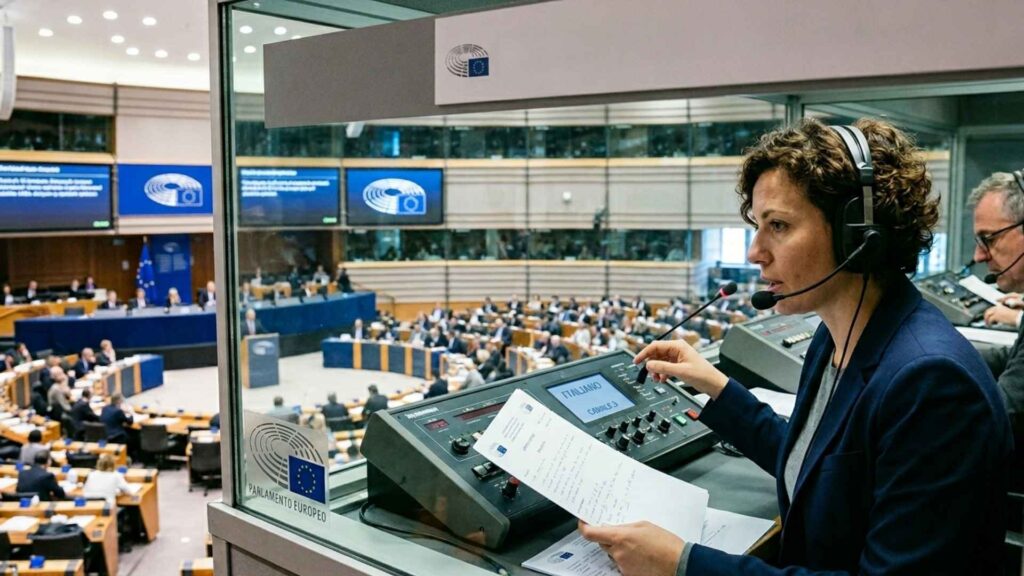
Behind every multilingual meeting is a carefully organised team of interpreters. The size of the team depends on the number of languages involved. For meetings with up to six languages, there are typically two interpreters per booth. When seven or more languages are involved, three interpreters per booth are required. In the most complex scenarios, when all 24 official languages are in use, a full interpreting team can include up to 72 interpreters working together.
All meeting rooms in the European Parliament’s main workplaces are equipped with soundproof booths that meet international ISO standards. But interpreters don’t work alone: they are supported by conference technicians who manage and maintain the equipment before and during meetings, ensuring everything runs smoothly. And interpretation doesn’t just happen in Brussels or Strasbourg. The Parliament also provides interpretation services during official missions and visits around the world.
Different ways of interpreting
Not all interpretation is the same, and the format depends on the situation. Simultaneous interpretation is the most common: interpreters translate in real time from soundproof booths, while participants listen through headphones. It’s fast, efficient, and essential for large multilingual meetings.
Consecutive interpretation, on the other hand, happens after the speaker has finished talking. The interpreter, usually sitting next to the speaker, reproduces the message using notes. This is often used for bilateral meetings, formal speeches, or interviews. There’s also “chuchotage”, a more informal method where the interpreter whispers the translation directly to a participant. And in situations where booths can’t be installed, a portable system known as a “valise” is used for simultaneous interpretation on the go.
Innovation and flexibility
The Parliament’s interpretation services are constantly evolving to adapt to new needs. For very specific situations, “ad personam” interpretation can be provided, offering tailored linguistic support to individuals. Another growing practice is remote interpretation, where interpreters are not physically present in the room but work from a distance using video and audio systems that allow them to follow the meeting in real time. It’s a flexible solution that complements traditional setups, without replacing them.
In the end, interpreters are the invisible bridge that keeps European democracy running. Without them, the Parliament simply couldn’t function the way it does today. Because in a Union built on diversity, understanding each other is crucial!